



This written essay will also be accompanied by an audio recording of me reading it. Those listening should still scroll through to see the relevant images and links.
As you can imagine, my essays take a lot of time and effort to produce and to bring to you. As a 26 year old independent writer, your support of my work through paid subscriptions is vital for me to be able to continue bringing my insights to you. You can upgrade to a paid subscription by clicking on the “subscribe” buttons in this post.
You can also support my work by liking, commenting and re-stacking or sharing my essays. All of these things help the algorithm to bring this content to those who may find it beneficial.
“My kid came out as trans. What (the hell) do I do now?” is probably a question you’ve Googled at least once in your lives, if you’ve managed to find my Substack.
If you’ve found this post, you’re either a parent of a kid who; identifies as trans, is experiencing gender dysphoria, is pursuing gender transition or you’re a clinician working with this population, consuming tons of information including many perspectives of transitioners and detransitioners, and you’re trying to understand what to do next to help the young person in your care. Or perhaps you’re just interested in the stories that people with experiences like mine have to tell. In any case, welcome to my Substack.
My name is Maia, and I am 26 years old. From the ages of 12-24 I was convinced I was born in the wrong body.
During that time, I lived an existence which ranged from the relative mundanity of navigating middle and high school with extreme autistic confusion about reality itself, beginning the process of binding my breasts, eventually getting diagnosed with ADHD and medicated for it, finally learning to tie my shoes at the end of my freshman year of high school, becoming a high school debate champion, going off to college, quitting debate because the college debate circuit sucks, secretly beginning the gender transition I'd been planning for six years that my parents were very clear they disapproved of — hence my secrecy — all the way to the insanity of my parents sending me to the Middle East for a study abroad hoping I'd quit my gender transition, only for me to continue my elaborate cosplay.

For the next half decade I pretended to be a guy in the risky environments of orthodox Jewish and Palestinian Muslim communities in Israel. Not a single article or detransitioner testimony that my parents sent me made a dent. And they tried that. A lot. It actually took not one but two wars for me to become so disillusioned with the impracticalities of transition that in the wake of moving back to the States after living through the horrors of October 7, I decided to quit the gender transition I had spent half of my young life, planning my forever around. And now I talk about it. A lot.
I started telling my story on podcasts about six months after I quit my gender transition, and much to my surprise, people thought my life story was remarkable and wanted to hear more of my reflections. In retrospect, I can understand why my stint of living as a pretend man in the Middle East was interesting to a Western audience, though at the time I thought my life was pretty normal.

But that aspect of my life isn’t even what I spend most of my time these days thinking and talking about. I’ve moved off of the podcasts, which I went on far too soon, without enough time to adequately process everything that happened to me, and now over to this blog. Here I write about the overlap between autism and ADHD and gender dysphoria, and provide advice to parents and clinicians trying to figure out how best to help the young people in their lives. I also work one on one with ROGD families and give them my two cents about how to help their kids navigate the profoundly difficult process of trying to figure out which gender they are and what that means about how they ought to live their lives. All of these things are fundamentally complex, highly intellectualized thought experiments occurring in often very young people who lack the life experiences which adolescents in a healthier time routinely used to develop an eventually stable adult identity. Their parents are understandably concerned, and often even quite panicked. Just like mine were back in 2012 when I came out to them as trans.
So truthfully, neither the teenagers nor their parents who are going into this experience of navigating gender dysphoria in a family dynamic really want to be there. Yet here we all find ourselves.
So, parents, understanding the high stakes of how they handle this, go online. Just like mine did back in 2012.
What the internet tells parents of kids who come out as trans

There is a lot of content available right now for concerned parents of trans-identifying kids that simply did not exist when my parents were trying to figure out how to help me when I came out to them as trans in 2012 as a twelve year old. Nowadays there are internet forums, blogs, podcasts, books, Substacks, therapists, parent support groups, clinical resources, online classes, and various parent coaching programs.
Most of the content available to parents of newly out transgender-identifying or gender-questioning kids falls into one of two camps: either it affirms the trans identity without question and tells parents to get on board and immediately get onto the chemical and then surgical castration or breast amputation train, or it treats the trans identity as an ideological contagion and tells parents to resist it by any and all means necessary, including by removing internet access of the gender-questioning child specifically and isolating them from most if not all of their friends who either also think they're trans or who will, out of a pro-social impulse, go along with it because your child is in fact their friend.
There is very little nuance available to families, nor are there many in-depth analytical explanations to help parents understand how their well-intentioned parenting strategies — be they affirming or non-affirming — are likely to land with their kids in the long term, and critically, why. Parents who want to find this type of nuance have to spend additional hours of their time desperately searching for it. So quite often, they do.
These days, parents of newly out trans teens find themselves eyeballs-deep in various online forums with their peers, trying to discern these nuances from the accounts of other parents of other kids, trying to conjecture about whether any of it applies to their kid. Sometimes they find themselves in forums vehemently opposed to any questioning of the validity of the child’s trans declaration, and other times they find themselves in forums which are vehemently opposed to those other forums.
Very quickly, parents of gender-questioning kids end up drowning in so much information that gives them such conflicting messages that they feel they might explode from the overwhelm, as they are trying to manage the needs of one very distressed kid alongside the needs of the others. Both sides of the culture war on trans issues are telling parents that failing to do the thing they recommend will mean that they are failing their kid and dooming them to harm.
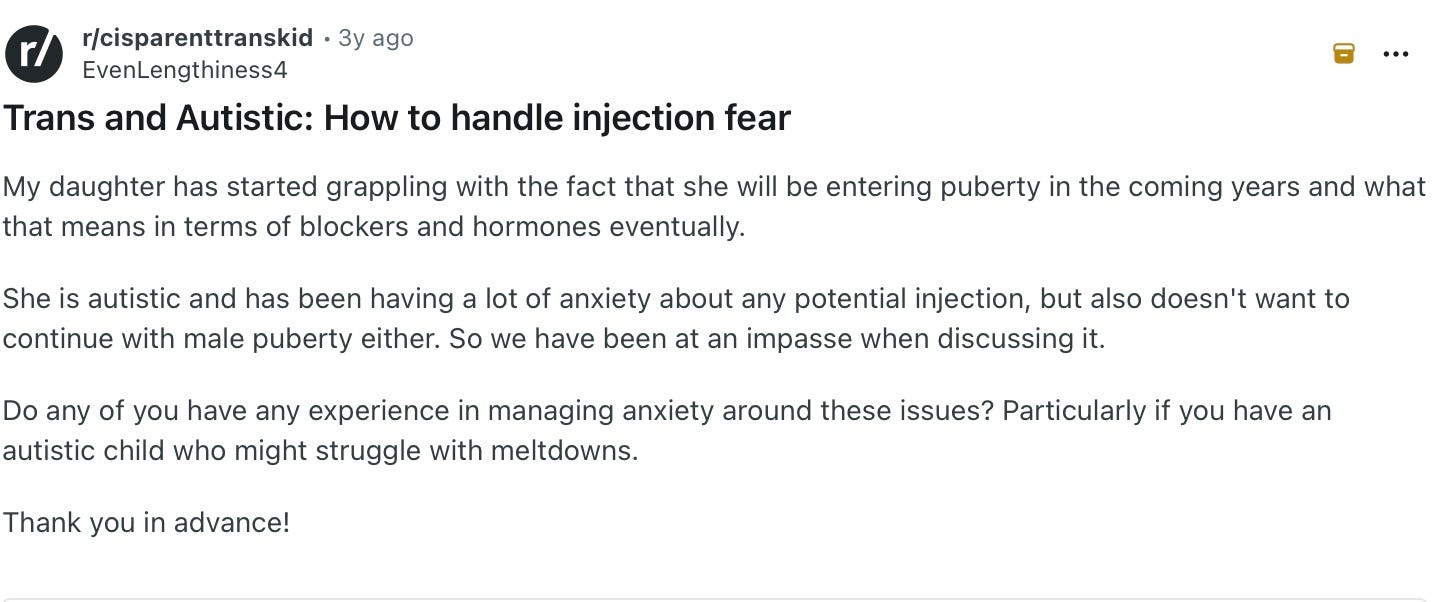
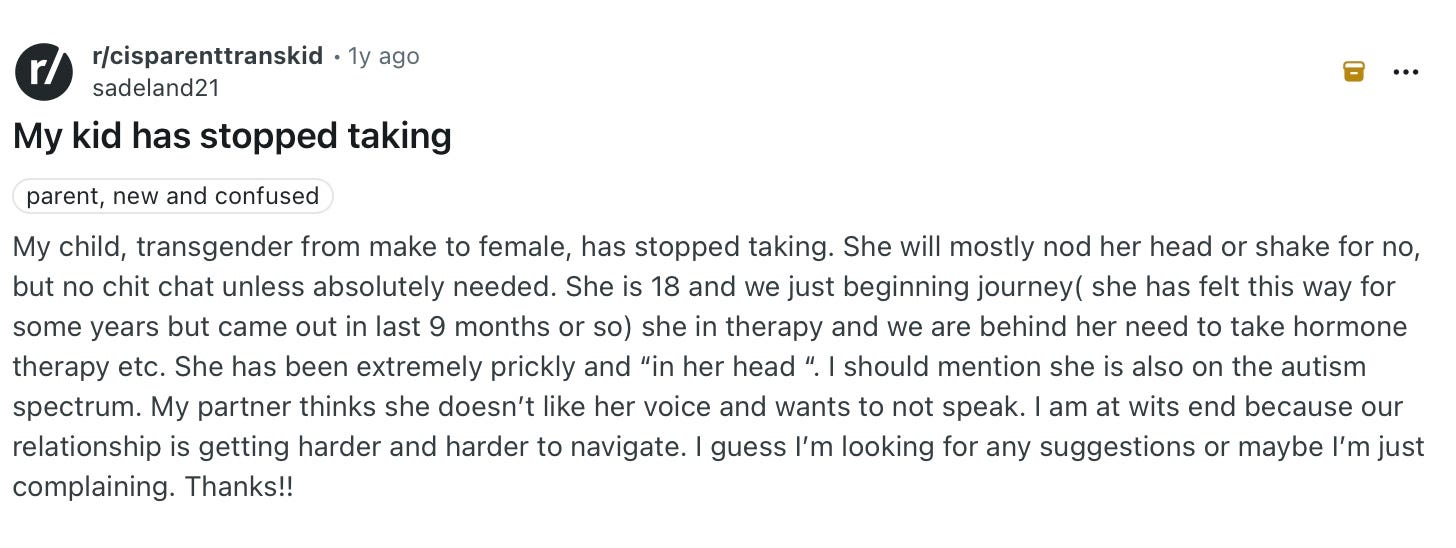
Both in parenting forums on pro-trans Reddit and in all sorts of ROGD parenting forums, I have noticed some clear trends in the profiles of the kids, as described by their parents: complex mental health needs of various kinds, but notably a lot of ADHD and autism. Parents of such kids still overwhelmingly find themselves online, often first going to trans kid parenting forums r/cisparenttranskid on Reddit, being told to unquestioningly affirm, and then realizing years down the line that the nature of their kids’ specific ADHD- and autism-related difficulties continue to cause additional problems as they go along the social and medical transition pathways.
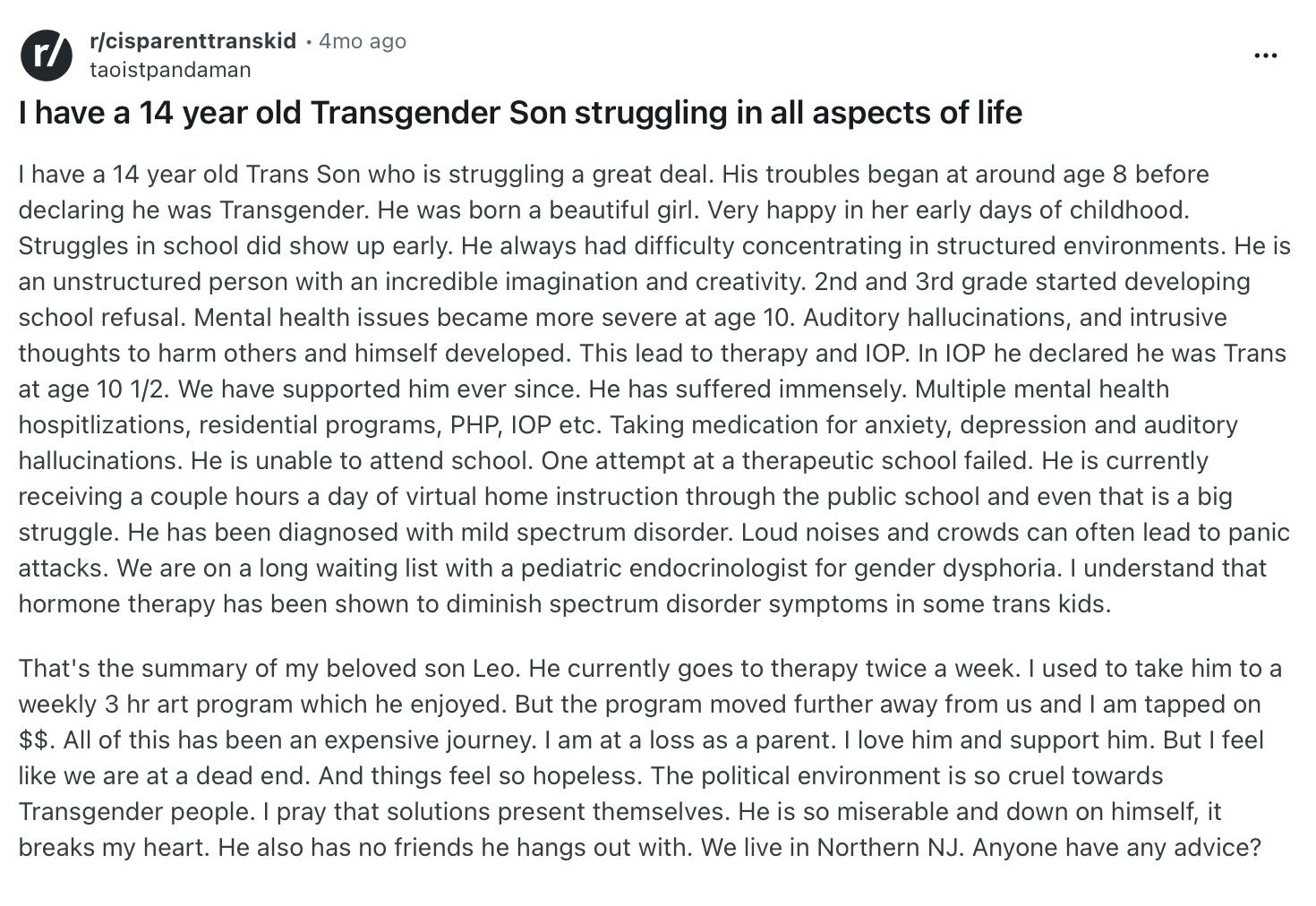
Parents who affirm their kids’ trans identities are being asked to navigate both the demands of regular life and the additional (special needs) of their autistic kids’ developmental delays, while also being tasked with deciding whether to consent to experimental treatments on behalf of kids who are very young and who, because of their additional social, emotional, communication, and sensory processing deficits, are even less equipped to communicate anything clearly with their parents. It is not uncommon to hear in those pro-trans parenting forums, how difficult it is for parents to make decisions that will impact their child’s future fertility, especially when their child is autistic and struggles to clearly articulate their “gender goals.”
So even for those parents who choose to partially or fully affirm the transgender identities of their kids and aren't attempting to navigate a million rainbow-colored institutional landmines, they too are faced with a lot of challenges endemic to the gender transition process and its many unknowns. Years down the road of gender affirmation, some of the parents in these online groups will discuss that their affirmed trans kid has become a mostly happy trans adult who unfortunately is also increasingly becoming a raging alcoholic, has deteriorating mental health, and is estranging from them or other family members due to "minority stress" and "internalized transphobia." Some might call these fancy words for doubts, regrets, or, more neutrally, unresolved underlying mental health issues. In the many trans-affirming parenting chats I've been in over the last almost decade and a half, there are also transitioned adults who describe mostly positive experiences of transition. Occasionally, teenagers will find themselves asking the once-ambivalent but currently affirming parents of adult transitioned kids for advice on magic words to tell their own parents to get them to affirm. There's a lot going on in these Reddit and Facebook forums, and notably, a ton of panic.
But then there are the parents who do not want to affirm the gender identities of their kids, and they are similarly met with parenting guidance that tells them to just say no, and to "hold the line." And years down the line of just saying no and holding the line, taking their kids off the internet, forbidding them from communicating with their trans-identifying or trans-supportive friends, their kids are still just as hell-bent on transitioning as they were before, their family relationships are suffering, and their kids are still failing to develop the necessary social and life skills they need to prepare for adulthood, and to responsibly navigate the very medical institutions their parents had thought that their “holding the line” strategy would prevent them from ever needing. Skills which are difficult enough to develop for fully mature, mentally stable adults with no social communication delays, let alone for a fresh eighteen year old autistic girl or boy. And then the parents who did everything they thought they were supposed to do begin to panic, because though for some other parents (who notably, do not describe their kids as having autistic traits) this strategy may have worked, for a lot of the parents I speak to whose kids are autistic or who have moderate to severe ADHD, this advice does not tend to yield positive results because it does not get to the root of the distress. I have more theories as to what explains this difference, based on my intimate understanding of the mental models of different types of trans identifying young people I have met over the last 14 or so years both online and in real life, and will touch on this briefly at the end of this essay- though it warrants an in depth explanation at some future point.
Something else I’ve noticed in my interactions with parents or my close following of trans-related parenting blogs over the years is that sometimes, some months or years into a younger kid’s gender questioning, parents will take this as a sign to get their kids diagnosed with autism. But the autism organizations are really woke, and so feel unable to help the gender questioning kid with their actual autistic problems without going against the parents’ wishes to not affirm the new gender identity over the course of diagnosis or any relevant support programs. Other times, if you are like my parents, you will see your kid getting an autism diagnosis as an unnecessarily stigmatizing step, and will instead send your kid to the first gender critical therapist you can find, hoping that will do the trick. But here’s the thing: if your kid is autistic, and their therapist cannot recognize it because they lack a good working model of autism, there is a chance that your kid, like me, will not have adequate social or emotional understanding to benefit from psychotherapy as an adolescent or as a young adult. If a clinician relies on entirely sterilized diagnostic language and is unable to make the diagnostic criteria of autism and adhd “come to life” in a way parents can see within their own kids, your kids will not thrive under their care. That is my opinion. And also, let’s be honest. Therapy will only work if your kid wants to be there, and only when any underlying strife in the family dynamic is also addressed simultaneously. It does not feel good to be seen as the lifelong problem child in your family who always gets sent to some kind of psychotherapy and comes back to a home environment where nothing has changed. I really do see family-based interventions and parenting-based interventions rather than a sole focus on the adolescent’s gender distress as the problem to be ‘fixed’ either through affirmation or non-affirmation, as being the future of any responsible clinical response to these situations of pre-adolescent and adolescent gender questioning.
The prospect of parenting a kid through a gender crisis causes understandable panic in both parents who want to affirm their kids’ transgender identities and those who do not. I feel for parents these days, because you are surrounded by insane amounts of ideologically motivated and generic parenting advice, most of which does not even attempt to answer the deeper question of why so many autistic and ADHD youth like yours, identify as trans, and what that means for both effective parenting and for clinical work.
There's a huge gap in resources for parents of gender-questioning or trans-identifying teens who are also autistic, ADHD, gifted, or twice-exceptional.
To better understand that profile, you can read my last essay, titled “is my autistic kid really transmasc, or just masking her autism?”:

There’s a huge gap in resources for parents of gender questioning/trans teens who are also autistic, ADHD, gifted and/or twice-exceptional.

Here is what I think is severely missing from the current available resources for parents of at least half of the youth experiencing gender dysphoria: neurodivergence-specific parenting strategies, informed by the perspectives of transitioners and detransitioners who navigated these very issues in their own family dynamics with their parents as kids, teens and young adults, and who have since reflected on those experiences with maturity. I see this gap in several areas:
The ROGD parenting support gap. The conversation around rapid-onset gender dysphoria has produced a lot of valuable material about what is happening at a population level. We now know that the Gen Z trans phenomenon skews heavily female and is more attributable to social contagion than to an organic medical phenomenon. We know about gender ideology in schools, and about the low-quality evidence base of the interventions recommended by leading gender clinics. Very little of that framing tells a specific parent what to do on a Tuesday when their kid comes home from school in distress, perhaps months if not years into an adolescent identity crisis. There are now attempts to fill that gap through really comprehensive ROGD parenting courses and coaching programs for parents. But these materials are not focussed on the unique profiles of twice-exceptional, ADHD, and autistic kids, whose experiences of embodiment are inherently fraught due to significant sensory processing difficulties, which especially in girls, are well known to be more severe, more masked and which tend to get way worse at puberty and in other times of great hormonal fluctuation. The lack of focus on the role of sensory issues in gender dysphoria treatment alone makes any strategy which does not account for this as a baseline, very limited in its effectiveness at reducing bodily discomfort which these kids will experience regardless of whether they believe that they can or should try to change their sex. In other words, failure to address underlying sensory processing issues will mean that whether the kid desists, persists, transitions or detransitions, the sensory issues that are making their lives miserable now will only continue to impair their development. Having heard about the advice that some of the families I've worked with have received from previous professionals, I often think how well those strategies could have worked — if only the kids their parents describe did not have such fundamental struggles with understanding their emotions, with the basics of social communication, with executive function, and with sensory processing. The practical roadmap for parents of trans-identifying kids with special needs associated with neurodevelopmental conditions like autism and ADHD — and also with unusually high IQs or giftedness — which explicitly accounts for those differences, does not yet exist. I will be building that roadmap on this Substack.
Gaps in autism services: Most social skills curricula for autistic kids are built for kids with obvious support needs: kids who have been visibly struggling from a young age, who may be less verbal, who have already been identified diagnostically. The kid I am describing is not that kid. Your kid can monologue at you for hours about some niche within a niche topic without asking a single question. Your kid can debate philosophy online for three hours. Or perhaps conversely, your kid struggles to initiate a conversation about something outside of their special interest, or always tries to bring back every unrelated topic to their special interests. I was that kid. Your kid has probably been considered mostly fine, but highly intelligent, unusual and socially quirky for most of their life, and is only now being seen as really struggling as the demands of adolescence increase, especially if your kid is a girl. The autism services world has almost nothing tailored for this profile, and what little it does have was not designed with gender distress in mind, despite this specific autistic and ADHD profile being so uniquely susceptible to it. Many of the parents I've consulted begin to understand only from the moment their quirky, sensitive, developmentally uneven but simultaneously gifted kids come out as trans, that those kids might actually meet the diagnostic criteria for autism. And it is truly saddening to hear how torn these families are about even getting their gender-distressed kids evaluated, precisely because of how gender-affirming autism services tend to be, especially in big cities. Functionally, this means that parents are stuck. They know their kids have special or additional needs, even if, like my parents, they would never want to use that word to describe their kids.
The gender clinic gap in legitimate autism awareness. The clinical pathway most commonly offered to trans-identifying youth (at least in the United States) does not properly assess for autism and ADHD, does not account for the full scope of a child’s developmental needs, and does not have good answers for parents who are concerned. Many of the families I work with have been told, explicitly or implicitly, that questioning a trans identity is harmful and that the only responsible path forward is affirmation and eventual social and medical intervention. Whatever one thinks about that as a policy position, it leaves parents who have legitimate concerns about their autistic child’s capacity for informed consent, especially from the moment they turn 18, with nowhere to go.

The therapy gap. I'll speak from my own experience as someone who grew up basically raised by speech therapy, occupational therapy, physical therapy, and psychotherapy of all kinds. Most therapists are totally incompetent, and most parents seem to believe their kids are getting something incredible in therapy that they themselves cannot give their own kids.

My own parents sent me to a few gender-critical therapists alongside plenty of other therapists for non-gender-related things, mostly for my myriad of developmental delays. The only good experience I've had in psychotherapy was with a therapist I already wanted to work with, after I had already realized I didn't know how to work my way out of the gender transition I'd invested half my life into. I made that decision by myself. There are some real gems of therapists I’ve met in the gender space who are very skilled and enjoyable people. That said, kids who already spend most or all of their free time being "fixed" by a plethora of mostly incompetent clinicians for most of their lives, which was my exact situation due to my developmental delays, tend to continue to feel that they are fundamentally broken. That does not help them develop the confidence or the skills to understand themselves as flawed but not broken human beings. Sending your gender-questioning kid off to therapy, even to a "safe" therapist, should not be taken lightly. Treat psychotherapy as seriously an intervention as you would a psych med, because therapy can actually make people feel worse and more hopeless. That has happened to me a ton, and I know I’m not alone. It is especially important to consider re-evaluating an over-reliance on sticking malleable teenagers in talk therapy, because most of the time the kid does not want to be there, and absent a serious mental health issue, it would be wiser to spend that time and money building a relationship with your own teenager.
The parent coaching gap. The families I work with are often not looking for someone to tell them what to think about gender. They have already done that thinking and have come to their own conclusions. What they need is someone who understands this specific profile from having lived it and studied it to better understand themselves and the other youth in that cohort, who can help them communicate with their child more effectively, and who can give them practical tools that are actually tailored to the way their kid’s brain works. There are a couple other parenting programs and parent coaching services available for ROGD families. While it is clear to me that for non-autistic, non-adhd kids, some of these services are really helpful investments of time and money for their parents, I haven’t found one that specifically caters to parents of autistic and adhd kids, who in my experience and based on extensive deep dives into the literature, are quite likely to themselves also have traits (if not diagnoses of) the same conditions. This added layer of complexity makes it critical for parents of such kids, and for the therapists working with families in these cases, to have a far deeper understanding of how various aspects of life are experienced by autistic and adhd people, intergenerationally. The importance of neurodivergence-specific parenting support for parents of gender dysphoric kids should not be underestimated. For this type of understanding to be achieved, the DSM-5’s diagnostic criteria must be brought to life. These experiences must be written about and studied deeply, freely and absent from ideological bias. That is something I plan to explore further in my upcoming series.
The detransitioner perspective gap. There is a growing body of detransitioner testimony available online, but most of it is narrative rather than analytical. Naturally, this format appeals to parents, who in the absence of actionable strategies (or out of sheer desperation) often send these to their kids, who do not receive them well. Someone else's transition regret is not going to speak to your twelve-year-old or to your high schooler. Your kid is trying to communicate something to you with the only words they have been given by our society. I was in your kid's position fourteen years ago. I found detransitioner testimonies on my own while still trans, and as an adult. I engaged with them not because my parents sent them to me, but because I had already lived through the first of the two earth-shattering events that made me rethink my life, and as I did, my algorithms followed suit. Those stories were helpful in thinking things through, but watching them still did not make me detransition. They actually made me so sure I was a true transsexual because the presentation of my gender issues was so different from those of girls who realized they regretted transition because they’d been denying themselves the femininity which I thought was a sensory and social hell that I was trying to desperately escape the expectation of performing. Watching detransitioners’ testimonies in the beginning made me more compelled to continue my gender transition despite my own increasing ambivalence because I was never given the skills needed to recognize my own ambivalence or my own doubts. I write more about this in my essay "I'm a detransitioner. Stop sending my essays to your trans-identified kid."
What is compelling for adult parents to watch is usually in no way compelling to their kids, who are in very different life stages. What would be far more useful to kids is something different: parenting and clinical strategies derived from an actual framework based on the inside experience of someone who was once happily trans — describing not just what happened, but why it happened mechanically, and what might have successfully interrupted it at different stages of development.
I'm a Detransitioner. Stop Sending My Essays to Your Trans-Identified Kid.
·
Note: the play button at the top is not a decoration, it is a recording of me reading my essay.
The autism/gender dysphoria overlap research gap. Research on the overlap between autism, ADHD, and gender dysphoria has grown significantly in the last decade. That finding has made it into academic journals. It has not made it into anything practical that parents can actually use on a Tuesday. Nor has anyone come up with anything resembling an intellectually rigorous explanation. That’s what I’m hoping to do here.



All of those gaps point to the same thing: there is a specific population of kids who are bright (but may have learning disabilities of different flavors), who are so sensitive (to sensory input, including often the emotions of others) that they struggle to understand how to parse and describe their own emotions, who are either socially anxious, or too socially oblivious to be socially anxious, but they lean towards perhaps being more sensory-anxious, who are ‘neurodivergent’ in ways that may or may not have been formally identified, who are experiencing gender distress in a way that is deeply connected to their neurodevelopmental profile. And there is almost no practical resource that addresses all of that together, from the inside, with enough specificity to actually be useful for parents, rather than just to seem useful.
This brings me to the deeper problem underpinning all of these gaps.
One side of the culture war, the trans-activist side, takes a child’s words far too literally. The other side, the gender-critical one, dismisses the child’s experience too quickly. The trans-affirming side over-ascribes wisdom to the young child. The gender-critical side removes too much agency from the teenager. And in both cases, the actual drivers of the young person’s distress remain untouched. This is why it is important for parents to not allow the culture war’s talking points to parent your kids, no matter how tempting it may be, especially in intellectually oriented Jewish families like mine (because, who doesn’t love a good debate?)
There is also a tendency to talk about “the trans community” as if it is a single, unified thing. Speaking as someone who was an insider for twelve years, online and in real life, in both the West and the Middle East — and now two years an outsider who has self-selected for a more self-aware and multigenerational group of transitioners: it just isn’t.
There are multiple trans subcultures, and they are constantly at odds with each other. Some are more gender-ideological, others are classical transsexualists, others are simply friend groups with heterodox beliefs, and some are even explicitly gender critical. Some trans communities are really dysfunctional, toxic and bring out the worst of humanity’s traits. Others are way less dysfunctional. The same is true of detransitioners’ online and in real life communities. Treating all of it as one thing prevents parents from understanding what their child is actually engaging with, and more importantly, why. And without that understanding, you cannot intervene effectively.
“Maia, what can I say or do to snap my kid out of this????”
(This section will be very, very honest and blunt. If this isn’t your thing, don’t read it. If it is, welcome to my Substack.)

Here is my honest answer to that question.
I tend to dislike giving generalized advice to parents who ask me for it when I know absolutely nothing about their kid or the family dynamic, because each of these situations, though they share patterns, are actually very different.
I’ve spent 12 years inside trans communities online and in real life, in the West and in the Middle East, and have watched these communities from the outside for the past two and a half years since my detransition. I know plenty of detransitioners whose family relationships don’t improve after detransition, because of the hurt accumulated on both sides, and the incapability of one or both parties to work through that maturely. I know kids from gender-affirming families who are estranging from those affirming parents because of pre-existing dysfunction that the gender transition never addressed. It is never as simple as “my kid will certainly estrange from me if I disagree with them about gender.”
I’ll say something that I think gets lost in most advice you’ll find online: the cultural context in which you’re raising your kid matters enormously, in ways no parenting forum will ever address. If there’s anything I’ve learned from pretending to be a man in the Middle East for half a decade, it’s that the West and the East each have their own unique version of insanity: both attributable to ideological dogmatism, and each shaped entirely by whether that society runs on individualism or collectivism.

The Western culture of hyper-individualism in which you’ve chosen to raise your kids carries a specific cultural hazard: families becoming untethered from their roots and engaging in estrangement over things like hurt feelings. In its most extreme form, it’s considered acceptable to abandon your family over an ideological disagreement. In its less extreme form, you get people who are free to live as they please and to be as eccentric or as normal as they wish to be.
In the most extreme form of Middle Eastern collectivism, you get honor killings. I have had Palestinian friends who were honor killed by their fathers or uncles for being gay. I have a friend whose childhood classmate was raped by her own brother in middle school, and her father killed her for bringing disgrace upon the family, despite the fact that she was the victim. Those Middle Eastern societies don’t have widespread gender confusion precisely because everyone has agreed on which sex class gets raped and killed, and which sex class does the raping and killing. To Westerners, that mindset is unconscionable. To this type of Eastern mindset, letting your kids be gay or trans (and still alive) is equally unconscionable.
In collectivism’s less extreme form, you have a society that is restrictive by Western standards but where ideological disagreements don’t tend to cause family estrangement; largely because nobody is permitted to voice them. Nursing homes practically don’t exist, because children are taught from early on that they have a duty to care for their parents in old age. For those of you who, like my parents, are immigrants: there is a reason you chose not to raise your kids in those societies. By choosing the West, you chose constant change, chaos, and instability in exchange for freedom and opportunity. That includes your kid’s freedom to do things you profoundly disagree with. And your freedom to decide how to respond. The greatest wisdom I’ve gleaned from my Eastern European roots is that unlimited freedom scares the living daylights out of people. People need constraints to function in an existence tethered to gravity rather than one floating aimlessly through space, but not so many restrictions that they suffocate. Our Western societies have not achieved this balance even though we are more capable of doing so than our Eastern counterparts.
There are far broader societal themes that need to be unpacked to understand the full scope of how we’ve gotten here. Maybe, as extremes go, it’s preferable to live our type of insanity than to live in a society where honor killing your child for disobedience is considered acceptable. There is always a way back from estrangement, for as long as both parties are alive. That’s my point.
Now. Anyone who promises that your kid will change their identity if you just use their strategy is selling you snake oil. Neither I, nor anyone else can make that promise. It is easy to manipulate the circumstances of children and pre-teens. It is much harder to manipulate the those of mid-to-older teens and young adult dependents. It is impossible to change the minds of self-sustaining young adults into making the decisions you think are best for them. At some point, they will have to learn through trial and error, and the state of their relationship to you will be the difference between them making really dumb choices versus making potentially catastrophic ones. I want to be very clear: I do not believe that anything as complex as adolescent identity development or gender distress has an easy or quick fix. That is not how reality works. And that is not what I’m offering.
You could try every strategy in the book and your kid might still transition.
There comes a time when parents cannot control the choices their kids make, and that time arrives far more quickly than most parents realize. The best thing a parent can do is understand this fact and build it into their parenting strategy from the moment their kid first confides this level of distress in them, at any age. Trying quick fixes and then becoming more radical when they fail is certainly something akin to a strategy — but it will very likely make things worse, not better. This includes: sending your kids my articles or those of other detransitioners instead of sitting with your child and his or her feelings. Sending studies about medical harms instead of having a face-to-face conversation. Taking your kid off the internet the moment they have thoughts you don’t like, while allowing everyone else in the house to continue their overreliance on it. Telling your kid they’re in a cult. Trying to convince them they’re wrong by telling them how much of a girl or boy they are, and showing pictures of them as toddlers in gender-typical outfits you chose for them. Restricting their social world to nothing. Forcing them harder into gender conformity. Telling them how upset their thoughts make you feel. Mourning your living child in front of their face. Enlisting siblings to convince them out of it. Withholding warmth because their appearance upsets you. Penalizing them for speaking honestly to you. Telling them they are wrong about their feelings. All of this is as relationally inappropriate as letting your teenager run the household while allowing them to make medical decisions they are developmentally incapable of understanding. To successfully navigate this, boundaries and warmth must coexist.
If there’s anything I wish someone would have told my parents back when I was 12, it would be this: “You are neither parenting a bad idea, nor are you parenting a walking, talking gender identity. You are parenting your whole child. Your child is struggling and she does not know how else to communicate this to you. Your duty is to help her learn how to use her words, rather than to argue with someone else’s words she is using as an echolaileic script just like she did as a toddler.”
The truth is, that your child who already has special needs, will eventually become an adult who will need a lot more guidance learning life skills and social skills than other people his or her age. This alone makes your child more vulnerable than their same-aged peers at any age. Not even the most compelling (to you) gender critical article will ever give your autistic, ADHD, gifted or twice-exceptional kid those life skills which they will need to stop being vulnerable to the manipulations of others because they probably lack the social intuition or attention span to understand that sometimes, people manipulate each other.
If your trans-identifying kid has sensory processing issues or extreme sensitivities, those will never be solved by a dinner table debate about trans women in women’s sports. What they need are parents and clinicians who help them become aware of how their sensory sensitivities impact their experiences of embodiment — with the eventual goal of helping the young person build their own non-gender-related understanding of how to feel better in their bodies. Every autistic or ADHD person will need this skill as they move through adulthood, regardless of whether they transition, because otherwise, transition will likely subsume their unconscious attempt to meet those needs, and they will probably lack the self-awareness to understand anything about their own motivations.
People who lack self-awareness are unlikely to make rational decisions, no matter how high their IQs are. In the absence of these skills, it could take your kid literally living through a couple of Middle Eastern wars to realize that comfort in one’s own skin, when the actual source of that discomfort is a sensory processing disorder, will never be mitigated by gender transition, no matter how hard they try. I know, because that is what it took for me. But first, your kid needs to know that sensory processing issues can really make them that miserable. That this level of misery is not normal. And that there are non-invasive alternatives — ones that parents can make genuinely attractive to their kids without needing to dismantle their entire trans identity to do it.
If your kid has autism or ADHD, they will need more of your help than your other kids to make it into adulthood, and it may take them longer to get there. They will need far more targeted guidance than anything you’ll find in either a trans kid or ROGD kid parenting forum that doesn’t explicitly cater to smart kids with special needs.
I would advise every parent who is drowning in gender content to stop consuming it. If gender has become main rationale for increasingly more of your parenting decisions and the main content you consume, it will not help you parent your autistic kid through their autistic issues, or your ADHD kid through their ADHD issues which are merely being refracted through the lens of gender. Reading every article about transition-related medical harms will probably just make you go insane, and your insanity will also probably make your kid go insane. And that is not good for anyone.

Your gender questioning kids need a parent who can stay sane and grounded as their beloved child navigates whatever middle school, high school, and college will throw at them. They need the targeted, unglamorous support of being helped to live with the developmental profiles associated with their autistic and ADHD traits. Parenting your smart kid with special needs, through their adolescent gender identity crisis, will probably be one of the hardest and most character-defining things you have ever done. If done well, both of you will learn so much about yourselves from it. And you too, are a human being deserving of experiences of joy throughout this process with your child. You should not attempt to navigate this all alone. I, for one, am here. But also, build a local support system.
Social and medical transition are not, in my opinion, the most ideal life outcomes. I think transition is a path which should be avoided at all costs, because it is so invasive in every facet of life, and because in most cases far less invasive paths to peace exist. That is my personal opinion. But I also don’t believe that transitioning is always the most catastrophic, life-ruining scenario; yes, even when it ends in regret or ambivalence. I also think there are more and less responsible ways to go about doing it, if that is the choice that an individual eventually makes.
I actually have extremely mixed feelings about my own time in so-called gender transition. Rather than sitting with the full emotional complexity of that, I intellectualize it for you all here. Welcome to my Substack.
My hot take, as someone who was the kid in your kid’s situation not so long ago, and for a very long time:
It is far more important that you and your kid can bond throughout this process, at any age, because you can be the one to teach them to recognize their own doubts, rather than them outsourcing that to an ideological script about “internalized transphobia,” which repackages doubt for young people who are autistic and genuinely struggling to understand their feelings for what they are. I think it is far more important for parents to bond with their kids by giving them the skills they specifically need to become the best versions of themselves. Someday your kid will be out in the world making their own choices. The goal is to prepare them to choose responsibly and thoughtfully, rather than as a way to “stick it” to their parents, because they are still psychologically adolescents with the rights of adults and are locked in a protracted power struggle with mom and dad over their desire for independence. Like I was.
Some of you are parenting autistic and ADHD kids, or kids you’d describe as extremely gifted but socially awkward, or underperforming relative to their gifts — or who traits of those conditions, perhaps without a formal diagnosis. Some of you are parenting kids with more severe mental health issues, sexual trauma, or family instability. These populations need different things, but are often intertwined. My series will focus primarily on the neurodivergent population, though since trauma can produce presentations of autistic and ADHD traits even without a strong genetic propensity, many parents may find it useful regardless of a formal diagnosis. Sometimes the parents I work with share the same autism or ADHD their kids have. Sometimes one parent has it in milder form. Usually that parent is not the one who reaches out to me. Sometimes these things skip a generation. My series will also, I hope, be comprehensive enough to be useful for clinicians wanting to deepen their understandings with research and lived experience, and for parents who share some of their kid’s neurodivergence, and for so-called “neurotypical” parents. Btw, “neurotypical” is a term I hate but I use it for explanatory ease, to mean that someone doesn’t have clinically significant traits of ADHD or autism— though as I’ll re-iterate; maybe the other biological parent or grandparent of your kid does.
The skills I’ll teach in this series are the ones I passionately believe your kids (if they are anything like I was at their age) will need. In some cases, these skills could be enough to help your kid grow out of their gender issues or find less invasive ways of coping with them than transition. This has been the outcome of some of my clients’ kids so far.
For others, the success of a neurodivergence-informed parenting strategy may look like your kid developing genuine self-awareness and then choosing social or medical transition with as full an understanding of what they’re signing themselves up for as they can before embarking on the process, and not as something they feel they literally cannot survive without, so they make rash choices because they are drowning and just trying to hold onto anything that vaguely resembles a life raft. That is also an outcome that some of my clients’ kids experience.
I see both of these life outcomes as far better than cycling through quick-fix ROGD parenting moves which are born out of panic and usually just destroy the parent-child relationship for no reason.
The advice I’ll be giving in this upcoming series will be more general than what I give families one-on-one, where I get enough information to notice micro-patterns within broader patterns within individual cases. But it will still be specifically focussed on the needs of this population. It is probably the most comprehensive body of work I will have ever created. I’m not yet finished with it despite having spent too many hours staring at this computer screen, so I’ll release it in phases: one series on sensory issues, one on social skills, one on emotional processing, and one on the academic and intellectual development your autistic and ADHD kids will need to make it through adolescence and into young adulthood with the capacity to make truly informed life choices, while preserving the most important family relationships even in the face of the most immense of conflicts.
To account for that time investment, I’ll be raising my paid subscription prices by a few dollars a month. This will not affect current paid subscribers.
Subscribe now to be locked in at the lower price and to access the full series as it is released.
If you’d like my help with your kid’s specific situation before the full series is out, DM me to set up a parent coaching session.
And finally, I’d love your input as I build this neurodivergence-informed ROGD parenting series. Those of you who read my work regularly know that I don’t oversimplify what is genuinely complex, because I see that as a profound disservice to my readers and their kids. Naturally, that means everything I write is extremely long, including introductions to project announcements.
Let me know in the comments if there are specific questions you’d like me to address in the realm of parenting a kid through a gender crisis involving: sensory processing issues, social communication delays, a serious gap between a child’s potential and their observable accomplishment, and their ability to identify or understand their own bodily cues, including; emotions, tiredness, hunger, and so on. You can tell me about your kid’s specific presentations of autism and/or adhd, and if my content has helped you understand something about the relationship between that and their gender distress, tell me how. The more specific the question, the better advice I can give and the more precisely I can build it into this series.
Announcements:
Is your kid navigating gender questioning and neurodivergence, and you’d like my two cents on how best to support him or her?
If so, I offer parent coaching sessions to help you figure out how to best navigate your specific child’s situation, in a compassionate and practical way. If this is of interest, please DM me.
This is a very good essay and it actually addresses one of the big goals for our organization.
We’re not just trying to guide autistic kids, but their parents & clinicians as well.
We know what we needed as kids, what helped us, and what didn’t. That will be very useful information for both parents & clinicians.
Follow the money! It is $200,000 to $300,000 for the surgery and $1,200,000 for the non-FDA approved dangerous drugs patients must take for the rest of their life. Surgeons and pharma are making $billions by maiming our children for life and all belong in jail!